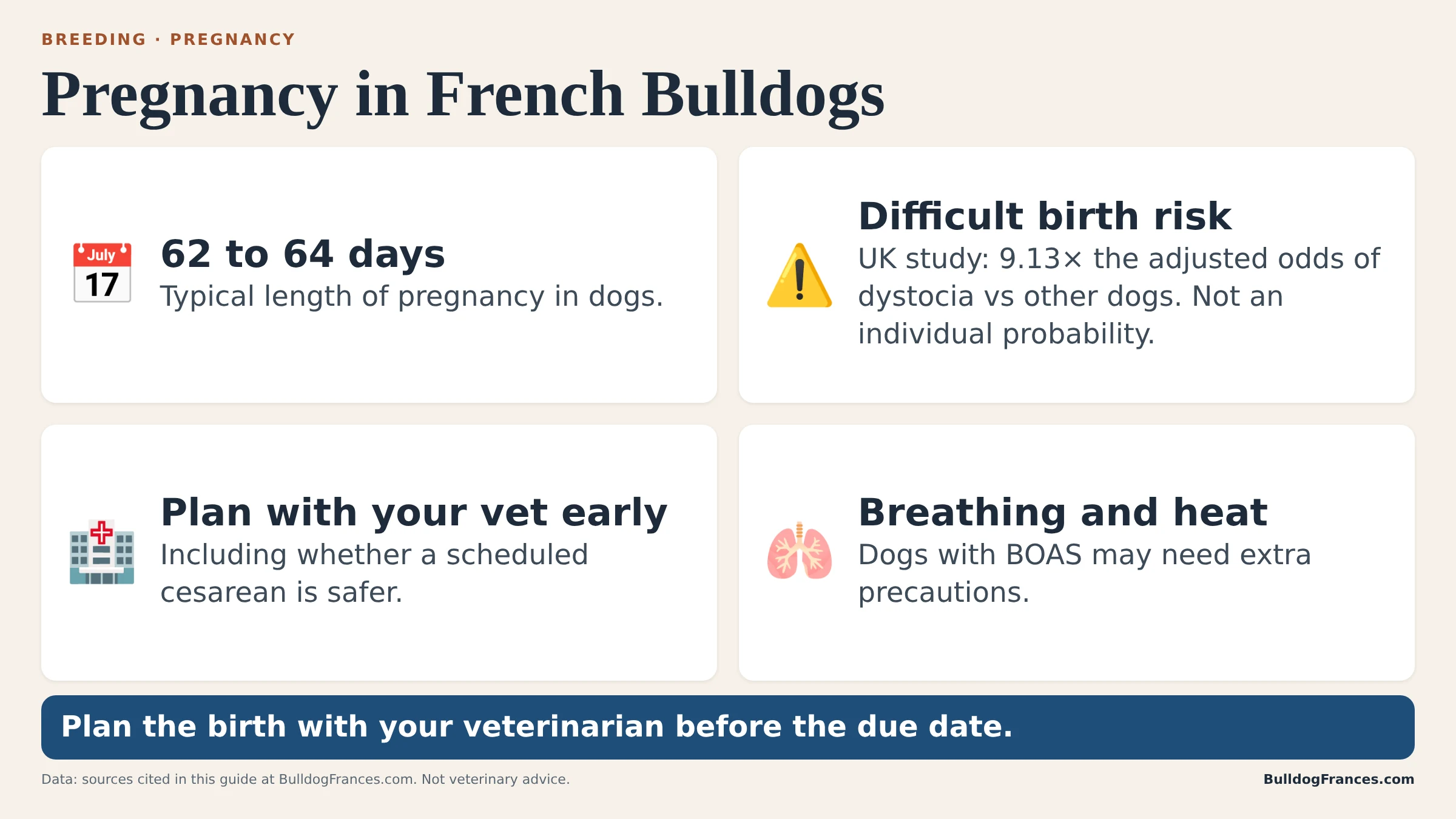
Pregnant French Bulldog care requires a veterinary birth plan because this breed has elevated odds of difficult delivery. Discuss pregnancy confirmation, fetal monitoring and emergency access before labor begins.[2]
Confirming the pregnancy
Pregnancy in dogs lasts about 62 to 64 days.[1] Your vet can confirm it with:
- Ultrasound: usually from about 3 to 4 weeks after mating
- Blood test (relaxin): generally around 30–35 days into pregnancy, depending on veterinary assessment.[1]
- X-ray: fetal skeletons become visible after about day 45; Merck notes that radiographs after day 55 provide the most useful estimate of litter size.[1]
Week-by-week care
| Weeks | Care |
|---|---|
| 1 to 4 | Normal diet and gentle walks. Ask your vet about deworming, parasite control and which medicines to avoid. |
| 5 to 6 | Begin moving to a puppy or growth formula as your vet advises. Feed smaller, more frequent meals. |
| 7 to 8 | Ask your veterinarian about late-pregnancy imaging, preferably timed after about day 55 when counting puppies; confirm the delivery plan and emergency clinic. |
| 9 | Short, calm walks only. Keep her cool. Many vets track her temperature in the final days. |
Keep her lean and comfortable. Do not give supplements such as extra calcium unless your vet prescribes them.
Why Frenchie births are high-risk
A Royal Veterinary College study found French Bulldogs had about 9 times the odds of dystocia, or difficult birth, compared with other dogs.[2] Potential contributors to difficult birth include maternal pelvic anatomy, relative fetal size or position, and poor uterine contractions. The precise cause in an individual dog needs veterinary assessment.[4]
Breathing is a second concern. Labor is hard physical work, and the breed is prone to BOAS, which causes noisy breathing and heat intolerance.[3] Anesthesia for a cesarean also needs a team experienced with flat-faced dogs.
Planning the delivery
- Ask your vet whether they recommend a planned cesarean section, and how they will time it.
- Find out what happens if labor starts at night or on a weekend. Save the emergency clinic number.
- Prepare a warm, clean whelping box in a quiet room.
- Have puppy supplies ready: towels, a heat source with a safe area to move away from it, a scale and a notebook.
Emergency signs
Call your vet or emergency clinic right away if she:
- Has intense, continuous contractions for around 30 minutes with no puppy; call sooner if she seems distressed.[4]
- Has dark green, blackish or foul-smelling discharge before delivery, which may indicate placental separation.[4]
- Has an interval longer than two hours between puppies while more are expected; veterinary evaluation is especially urgent when there are contractions or distress.[4]
- Goes beyond the delivery window estimated by her veterinarian, especially when ovulation timing or fetal monitoring raises concern. A mating date alone cannot predict the precise delivery day.[1]
- Has breathing trouble, collapses or seems very weak
Ask your vet to give you their own thresholds in advance, since they may differ for a planned cesarean.
After the puppies arrive
- Make sure every puppy nurses within the first hours.
- Weigh puppies at birth and frequently during the first week, following veterinary guidance. Unexpected weight loss or failure to gain requires prompt attention.[1]
- Check the mother's incision (after a cesarean), mammary glands and discharge every day.
- Watch for restlessness, trembling or stiffness in the mother, which can signal low calcium (eclampsia), an emergency.
- Keep the room warm but not hot, for the mother's breathing.
Related French Bulldog guides
Sources and references
- Davidson AP. Management of Reproduction in Dogs [Internet]. Merck Veterinary Manual; 2018 Jun [updated 2026 Jun; cited 2026 Nov 3].
- O'Neill DG, Packer RMA, Francis P, Church DB, Brodbelt DC, Pegram C. French Bulldogs differ to other dogs in the UK in propensity for many common disorders: a VetCompass study. Canine Medicine and Genetics. 2021;8(1):13. doi:10.1186/s40575-021-00112-3.
- University of Cambridge, Department of Veterinary Medicine. Recognition & Diagnosis [Internet]. Cambridge BOAS Research Group; [date unknown] [cited 2026 Nov 3].
- Merck Veterinary Manual. Dystocia in Small Animals [Internet]. Merck Veterinary Manual, professional version; [cited 2026 Nov 12].