Merle French Bulldogs look striking, but the gene behind the pattern is linked to hearing and eye problems. Here is what the research shows.
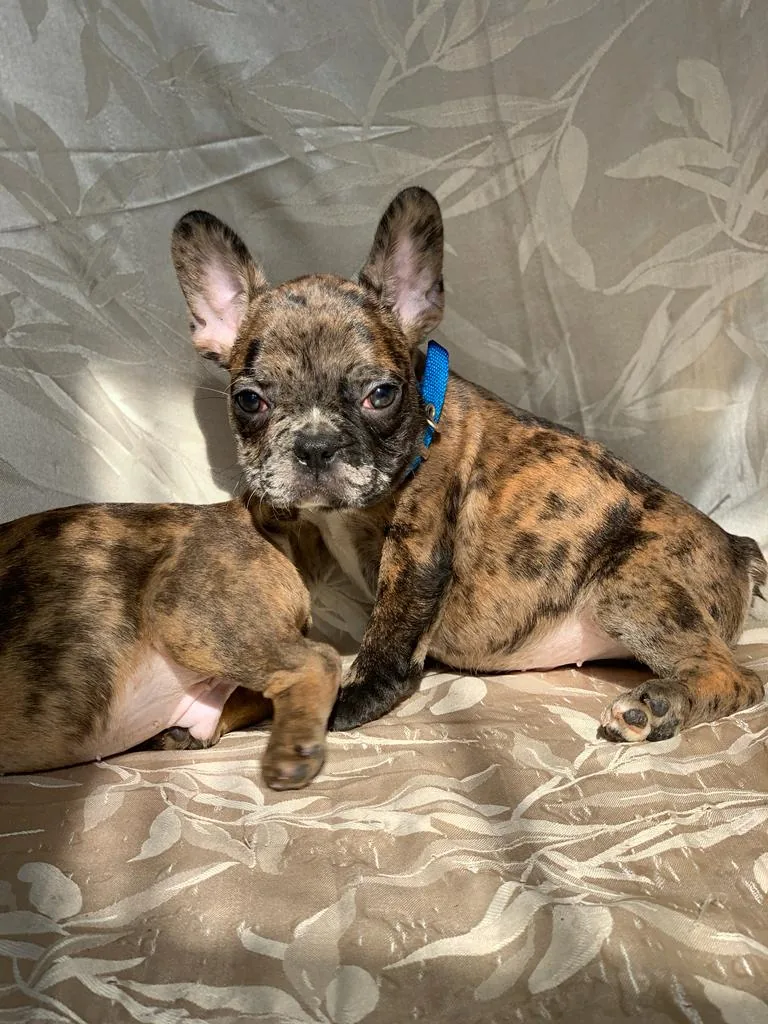
What "merle" means
Merle is a coat pattern of irregular, diluted patches over a darker base color. It is caused by an insertion in a gene called PMEL17, also known as Silver (SILV). The gene affects only black pigment (eumelanin), which is why merle shows up on black or blue coats and can be invisible on some fawn dogs.[1]
Merle is incompletely dominant. One copy is usually enough to show the pattern. Two copies, one from each parent, creates a double merle.[1] Sellers use names like "blue merle," "lilac merle" or "chocolate merle." These mix marketing language with genetics, and a label on a listing is not a DNA test result.
Is merle a recognized French Bulldog color?
The current AKC standard, approved in 2018, accepts "white, cream, fawn (ranging from light fawn to a red fawn), or any combinations of the foregoing" and names merle among the disqualifying colors.[3] In practice, merle is not part of the traditional breed.
The French Bulldog Rescue Network states that the purebred gene pool did not carry merle and that merle Frenchies were produced by introducing another breed, usually a Chihuahua.[4] That is the group's position rather than a lab finding, but it explains why many breed clubs and rescues warn against "fad colors."
Hearing loss: what the numbers say
The best data on merle and deafness comes from a 2009 study at Louisiana State University led by veterinary neurologist George Strain. Researchers tested the hearing of 153 merle dogs from several breeds using BAER, an electrical test of the hearing pathway.[2]
| Group | Deaf in one ear | Deaf in both ears | Total affected |
|---|---|---|---|
| Single merle (one copy) | 2.7% | 0.9% | 3.5% |
| Double merle (two copies) | 10% | 15% | 25% |
So most single merles hear normally, but the risk is not zero. Double merles are affected about seven times as often. The study did not focus on French Bulldogs, so treat these as general merle figures.
A dog deaf in one ear often acts normally at home, which is why owners rarely notice. Only a BAER test can confirm one-sided deafness.
Eye problems
UC Davis notes that merle dogs "may possess a wide range of auditory and ophthalmologic defects." Double merles may have hearing, eye, skeletal and other defects, and they often have a mostly white coat.[1] Reported eye problems in double merles include abnormally small eyes and structural defects that affect vision.
A board-certified veterinary ophthalmologist can examine the eyes in detail. This is the same CAER exam the breed club asks breeders to do every year.[5]
Cryptic merle: the hidden risk
Some dogs carry a short version of the merle insertion and show little or no pattern. UC Davis calls these "cryptic merle" (also phantom or ghost merle) and warns they "may be misclassified as non-merles."[1]
This is how accidental double merles happen. A breeder pairs a visible merle with a dog that looks solid, not knowing the second dog is a cryptic merle. A DNA test for the merle (M) locus is the only reliable way to know.
If you already own a merle Frenchie
- Ask your vet about a BAER hearing test, especially if your dog is a double merle or mostly white.
- Book an eye exam with a veterinary ophthalmologist if you notice squinting, cloudiness, bumping into things or eyes of very different size.
- Train with hand signals as well as words. They help any dog and are essential for a dog with hearing loss.
- Remember the rest of the breed's risks. Coat color is only one factor. Breathing, spine and skin health matter just as much.
A merle Frenchie can live a happy life. Knowing its hearing and vision status simply lets you care for it well.
If you are thinking of buying one
- Ask for the merle DNA results of both parents. Never accept a merle-to-merle pairing.
- Ask whether the puppy has had a BAER hearing test.
- Ask for the standard health screenings (hips, eyes, patellas, heart) and a breathing grade for both parents.
- Be wary when a seller's main selling point is the color. Rare colors often cost more but say nothing about health.
Related French Bulldog guides
- Double Merle French Bulldogs: Deafness, Eye Defects and Care
- White French Bulldogs and Deafness: Risks and Hearing Tests
- French Bulldog Health Testing: What a Reputable Breeder Should Show You
Sources and references
- UC Davis Veterinary Genetics Laboratory. Merle [Internet]. UC Davis Veterinary Genetics Laboratory; [date unknown] [cited 2026 Nov 3].
- Strain GM, Clark LA, Wahl JM, Turner AE, Murphy KE. Prevalence of Deafness in Dogs Heterozygous or Homozygous for the Merle Allele. Journal of Veterinary Internal Medicine. 2009;23(2):282-286. doi:10.1111/j.1939-1676.2008.0257.x.
- American Kennel Club. Official Standard of the French Bulldog [Internet]. AKC; 2018 Apr 10 [cited 2026 Nov 3].
- French Bulldog Rescue Network. Fad Colors [Internet]. FBRN; [date unknown] [cited 2026 Nov 3].
- French Bull Dog Club of America. Health Testing and Registries [Internet]. FBDCA; [date unknown] [cited 2026 Nov 3].
Last reviewed November 3, 2026. Educational information only. This guide does not replace advice from your veterinarian.