French Bulldogs are expensive, wildly popular and prone to inherited disease. That combination attracts people who breed for cash, not health. A reputable breeder can show you written, verifiable health results for both parents. Anyone who cannot is asking you to gamble with your money and with a puppy's life. Here is exactly what to ask for, what each test means, and how to check it yourself.
Why French Bulldog health testing matters so much
The French Bulldog has been the most popular breed in the American Kennel Club's rankings four years in a row, from 2022 through 2025.[4] Popularity attracts people who breed for profit rather than health, and the result shows up in veterinary records. A large study by the Royal Veterinary College compared 2,781 French Bulldogs with 21,850 other dogs in UK veterinary clinics. French Bulldogs had significantly higher odds for 20 of 43 common disorders.[5]
Some of those differences were large. Compared with other dogs, French Bulldogs had about 31 times the odds of being diagnosed with brachycephalic obstructive airway syndrome (BOAS) and about 42 times the odds of narrowed nostrils.[5] The authors concluded the breed "should, in many respects, no longer be considered as an 'average' or 'typical' dog."[5]
No test removes every risk. But parents with documented, good results give a puppy a far better start than parents with no records at all. "Healthy parents, trust me" is not a record.
The 4 required tests: hips, eyes, patellas and heart
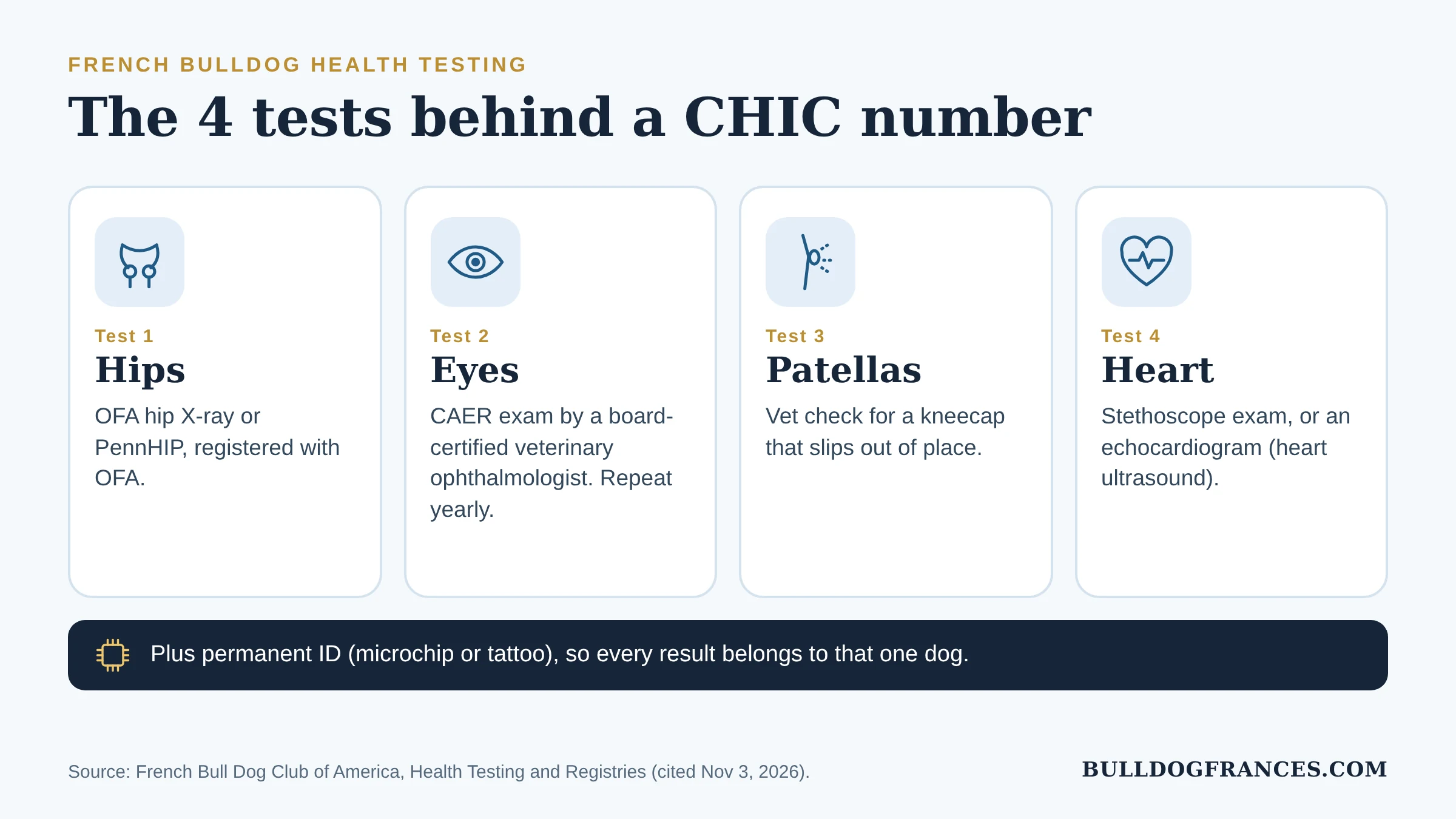
The FBDCA is the AKC parent club for the breed. Through the Canine Health Information Center (CHIC), it requires that a dog be entered in four registries before it receives a CHIC number.[1] The dog must also be permanently identified with a microchip or tattoo, so each result can be tied to that one animal.[1]
OFA is the Orthopedic Foundation for Animals, the US registry that grades and publishes these results. CHIC, the Canine Health Information Center, is a program OFA created with breed clubs to track the health problems that matter in each breed.[2]
Hips: what is an OFA hip evaluation, and what is PennHIP?
The club accepts one of two hip evaluations, with the results registered with OFA: an OFA radiographic hip evaluation or a PennHIP evaluation.[1]
OFA hip evaluation: a veterinarian takes X-rays and sends them to OFA for grading. OFA sorts hips into seven categories: Excellent, Good and Fair (all within normal limits), Borderline, and Mild, Moderate or Severe (the last three considered dysplastic).[6] Dogs from 4 to 23 months of age can only get a preliminary screening.[6] PennHIP is the other hip evaluation the club accepts.[1]
Ask for the actual grade. "Hips are OFA'd" tells you nothing. "Good" and "Mild dysplasia" are both OFA results.
Eyes: what is a CAER eye exam?
The club requires an eye examination performed by a DACVO, with results registered with OFA, and recommends recertifying every year.[1]
CAER is OFA's Companion Animal Eye Registry. Its purpose is to give breeders information about canine eye diseases so they can make informed breeding decisions.[7] CAER exams are performed by board-certified veterinary ophthalmologists, and a certification is valid for 12 months from the exam date.[7] DACVO means Diplomate of the American College of Veterinary Ophthalmologists. Only these board-certified specialists are authorized to provide CAER screening exams to breeders.[8]
An eye exam from two or three years ago is expired. Ask for the date.
Patellas: what is patellar luxation?
The club requires a veterinary evaluation for patellar luxation, registered with OFA.[1]
Patellar luxation means the kneecap pops out of place, toward the inside or the outside of the leg. For the OFA database, the dog is examined awake, and a number is issued only to dogs found normal at 12 months of age or older.[9]
Heart: basic cardiac exam or echocardiogram?
The club accepts either a basic cardiac exam (listening with a stethoscope) or an advanced exam using an echocardiogram, with results registered with OFA.[1]
In the OFA basic cardiac exam, the result is based on auscultation, meaning a vet listening to the heart. In the advanced cardiac exam, the dog is examined by a veterinary cardiologist, and an echocardiogram (an ultrasound of the heart) is always required. OFA cardiac evaluations are valid for one year.[10]
The American Kennel Club lists the same four evaluations as the recommended health tests for French Bulldog breeding stock, noting that an echocardiogram is "recommended but not required."[11]
Recommended extras: BOAS breathing grade, HSF4 cataracts, cystinuria
Beyond the four required tests, the FBDCA recommends tracheal hypoplasia (a narrow windpipe) and elbow dysplasia screening, plus the three tests below.[1]
What is the Respiratory Function Grading Scheme (RFGS)?
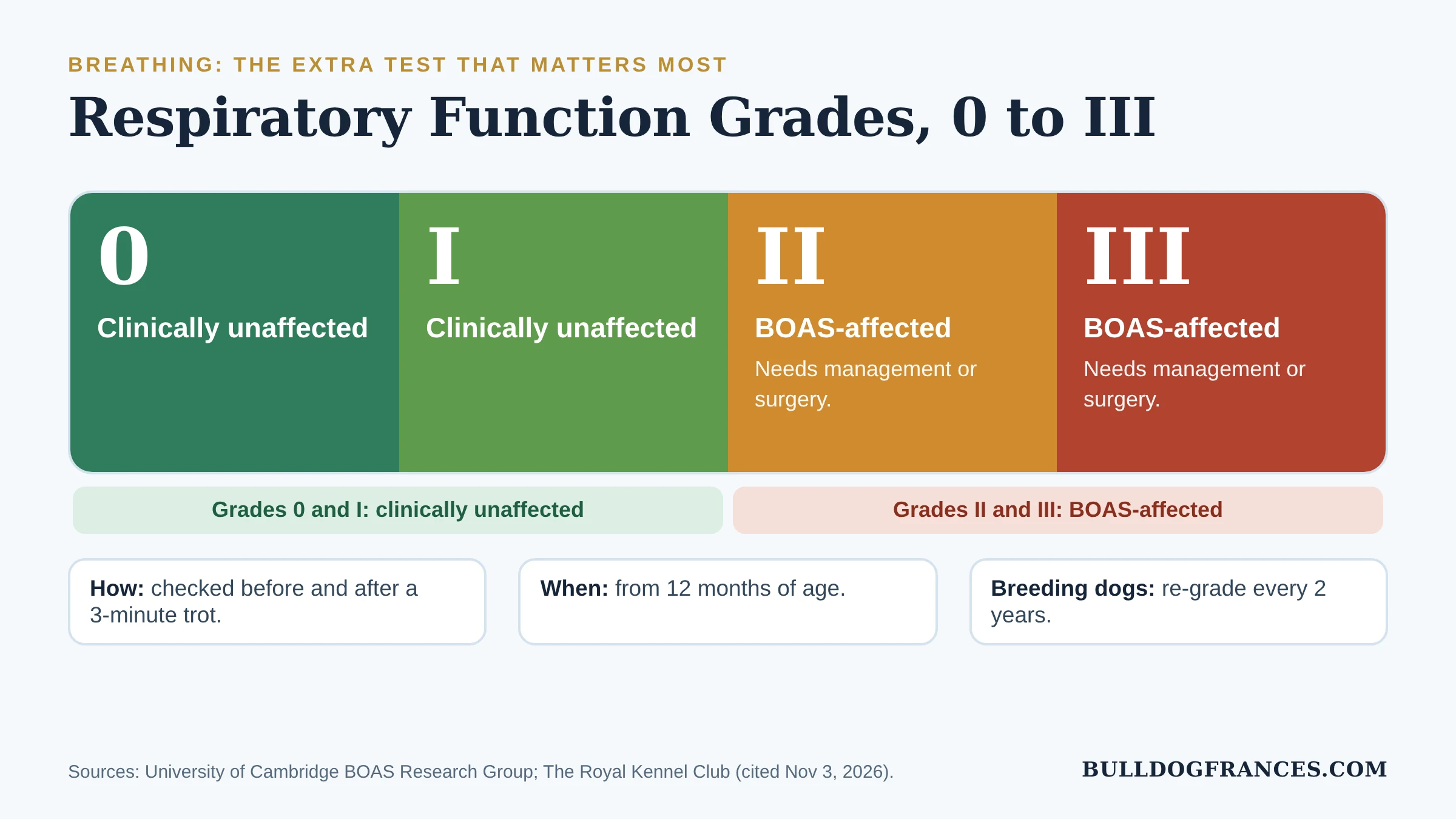
This is the single most useful extra for this breed. The RFGS is a structured breathing assessment developed by the University of Cambridge and the UK Kennel Club. A dog is assessed before and after a 3-minute trotting exercise test and graded from 0 to III. Grades 0 and I are considered clinically unaffected. Grades II and III are considered BOAS-affected and need management or surgery.[3] Dogs can be graded from 12 months of age, and breeding dogs should be re-graded every two years.[12]
A breeder who breeds Grade II or III dogs is knowingly passing on an airway disease. Ask for the grade in writing.
What is the HSF4 test for juvenile cataracts?
HSF4 is a DNA test for juvenile hereditary cataracts (JHC). On OFA certificates it appears as "HSF4-1". The club stresses that it is important to order the JHC / HSF4-1 test specifically for French Bulldogs.[1]
What is cystinuria type 3, and what is PennGen?
The club strongly recommends testing for cystinuria type 3 specifically through PennGen.[1]
PennGen is a group of genetic testing laboratories at the University of Pennsylvania School of Veterinary Medicine. It offers DNA tests for specific variants in specific breeds and can also test for cystine in the urine.[13]
Are color DNA panels health tests?
No. Many breeders advertise a "full DNA panel" that mostly covers coat colors. Color results are not health screening. A puppy's color tells you nothing about its hips, heart or breathing. When a seller talks more about color than about health results, you have learned what they are really selling.
What a CHIC number does and does not prove
A dog earns CHIC certification when it has been screened for every disease the parent club recommends and the results are publicly available in the database. OFA states plainly that the CHIC number "does not imply normal test results."[2] A dog with mildly dysplastic hips can still have a CHIC number.
That is why you should read each result, not just the number. Look at the test date, who performed it, and the actual grade.
How to verify a breeder's health claims on OFA
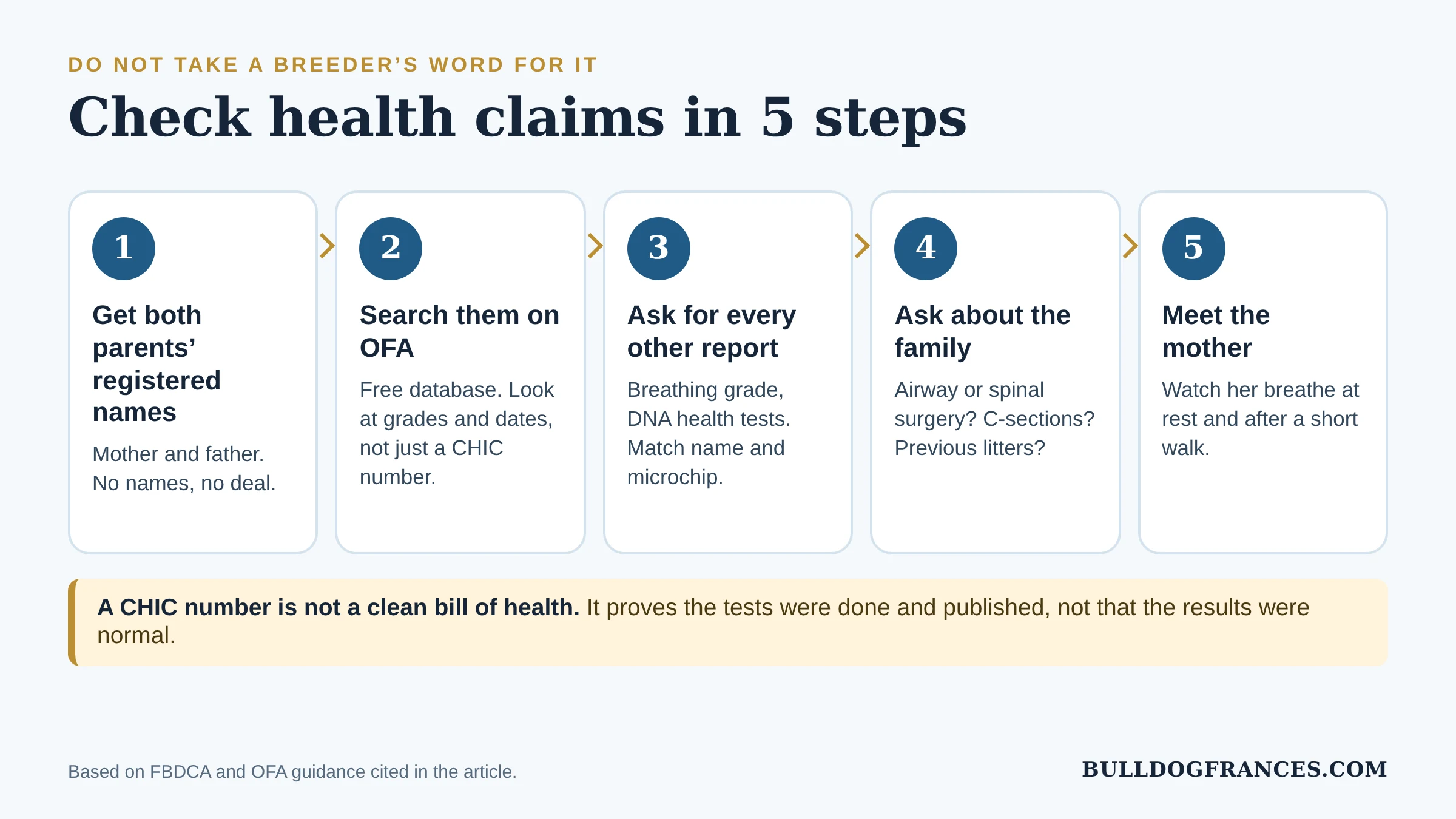
1. Get the parents' registered names
Ask for the registered names or registration numbers of both the mother and the father. A breeder with nothing to hide will send them the same day.
2. Search the OFA database
Search each parent at ofa.org. Results for hips, eyes, patellas and heart appear on each dog's page, with dates.
3. Ask for copies of every other report
That includes a respiratory grading certificate and DNA health results. Check that the dog's name and microchip number match on every document.
4. Ask about the wider family
Have siblings, grandparents or previous litters needed airway surgery, spinal surgery or cesarean sections? Honest breeders will tell you.
5. Meet the mother if you can
Watch her breathing at rest and after a short walk. Loud snoring while awake, gasping, or needing to stop and recover are warning signs.
Red flags of a backyard breeder
Any one of these is a reason to walk away, even if you have already fallen for a puppy in the photos:
- "The parents are vet checked" with no written results.
- Health claims that cannot be found in the OFA database.
- Heavy marketing of "rare" colors such as merle, or "fluffy" coats, instead of health evidence.
- Pressure to pay a deposit fast, or refusal to let you see where the puppies are raised.
- Puppies sold before 8 weeks of age, or shipped with no chance to ask questions.
- Parents that snore loudly at rest, struggle to breathe in mild weather, or have very narrow, slit-like nostrils.
Questions to ask a French Bulldog breeder, word for word
- "Can you send me the registered names of both parents so I can look them up on OFA?"
- "Have the parents had a breathing assessment? What grade did they get?"
- "Which DNA tests were health tests, not color tests?"
- "Has the mother had cesarean sections? How many litters has she had?"
- "Have any related dogs needed airway or spinal surgery?"
- "What happens if my puppy develops a hereditary problem?"
A good breeder will be glad you asked. Someone who becomes evasive or pushy has already answered your question.
Related French Bulldog guides
- Buying a French Bulldog: The Puppy Paperwork You Should Get
- French Bulldog Puppy Health Checklist: What to Check Before You Buy
- French Bulldog Snoring and Noisy Breathing: When to Worry
Sources and references
- French Bull Dog Club of America. Health Testing and Registries [Internet]. FBDCA; [date unknown] [cited 2026 Nov 3].
- Orthopedic Foundation for Animals. CHIC Program [Internet]. OFA; [date unknown] [updated 2022 May 20; cited 2026 Nov 3].
- University of Cambridge, Department of Veterinary Medicine. Recognition & Diagnosis [Internet]. Cambridge BOAS Research Group; [date unknown] [cited 2026 Nov 3].
- American Kennel Club. Most Popular Dog Breeds [Internet]. akc.org; [date unknown] [updated 2026 Mar 18; cited 2026 Nov 3].
- O'Neill DG, Packer RMA, Francis P, Church DB, Brodbelt DC, Pegram C. French Bulldogs differ to other dogs in the UK in propensity for many common disorders: a VetCompass study. Canine Medicine and Genetics. 2021;8(1):13. doi:10.1186/s40575-021-00112-3.
- Orthopedic Foundation for Animals. Hip Dysplasia [Internet]. OFA; [date unknown] [updated 2022 Jan 20; cited 2026 Nov 3].
- Orthopedic Foundation for Animals. Eye Certification [Internet]. OFA; [date unknown] [updated 2025 Jun 30; cited 2026 Nov 3].
- American College of Veterinary Ophthalmologists. ACVO Public [Internet]. ACVO; [date unknown] [cited 2026 Nov 3].
- Orthopedic Foundation for Animals. Patellar Luxation [Internet]. OFA; [date unknown] [updated 2022 Jun 8; cited 2026 Nov 3].
- Orthopedic Foundation for Animals. Cardiac Disease [Internet]. OFA; [date unknown] [updated 2023 Jun 26; cited 2026 Nov 3].
- American Kennel Club. French Bulldog DNA Tests [Internet]. AKC DNA Resource Center; [date unknown] [updated 2024 Jul 31; cited 2026 Nov 3].
- The Royal Kennel Club. Respiratory Function Grading Scheme [Internet]. The Royal Kennel Club; [date unknown] [cited 2026 Nov 3].
- University of Pennsylvania School of Veterinary Medicine. PennGen Laboratories [Internet]. Penn Vet; [date unknown] [cited 2026 Nov 3].
Last reviewed November 3, 2026. Educational information only. This guide does not replace advice from your veterinarian.