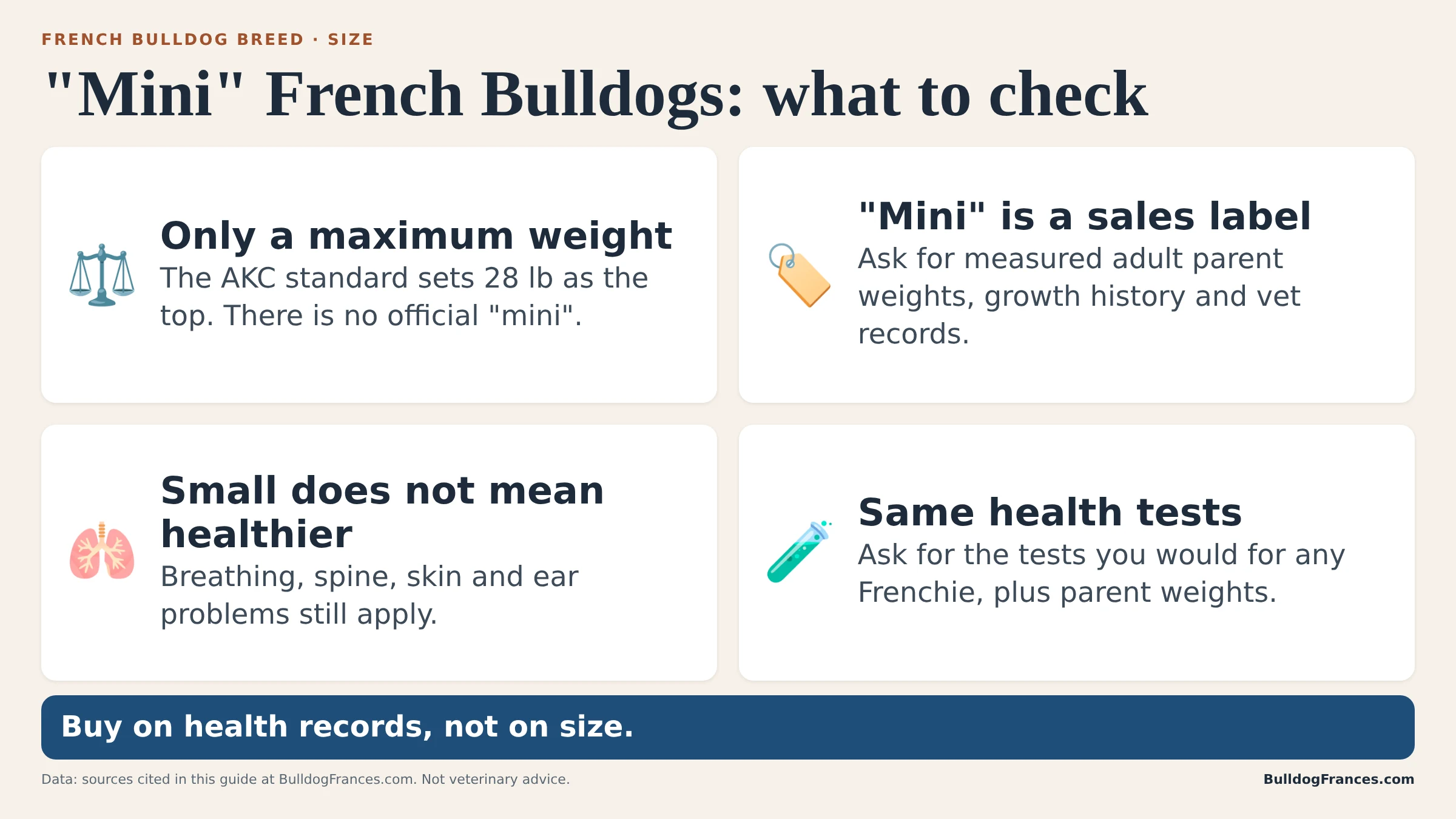
A "mini French Bulldog" is a marketing description, not an AKC size variety. Body size alone cannot predict airway health or establish a puppy's ancestry.[1]
Is a mini French Bulldog a real breed?
No. The American Kennel Club standard says "weight not to exceed 28 pounds; over 28 pounds is a disqualification." It sets no minimum and no separate size class.[1] Neither the AKC nor the French Bull Dog Club of America recognizes "mini," "micro" or "teacup" varieties.
Dogs advertised as "mini" may be naturally small or come from other breeding arrangements. Without verified pedigree and health records, the label alone cannot establish ancestry, future adult size or medical risk.
How sellers produce smaller Frenchies
Several explanations for unusually small size are possible, but the sources cited here do not establish how often each occurs in the market:
- Selective breeding for smaller size. Ask whether breeders can document parent health, adult size and related dogs; small size itself is not evidence of a hereditary disorder.
- Mixed ancestry. A dog may be crossed with a smaller breed, but this cannot be established from a "mini" label or small stature alone. Merle color history is not evidence that a particular miniature dog was crossbred.
- A puppy with unusually slow growth. Growth concerns warrant veterinary evaluation rather than assuming the puppy will remain a healthy miniature adult.
Health risks that do not shrink
A large UK veterinary-record study found increased adjusted odds of several conditions, including BOAS and stenotic nostrils, in French Bulldogs compared with other dogs.[2] That research did not compare dogs marketed as "mini" with other French Bulldogs. A smaller body does not, by itself, show that the airway is free of obstruction.
Spinal health also matters. The AKC lists CDDY/CDPA-related DNA tests among those available for the breed.[3] Genetic testing estimates specific variant status; it does not diagnose spinal disease or demonstrate that a smaller French Bulldog has more or less disease.
Extra concerns with very small dogs
Very small puppies may need more individualized assessment, but the cited sources do not quantify extra disease or anesthesia risk specifically for "mini" French Bulldogs. Discuss the following concerns with a veterinarian rather than treating them as proven breed-subgroup rates:
- Low blood sugar in young puppies if they miss meals
- Kneecap problems (patellar luxation), which the breed club already screens for[4]
- Dental crowding in a smaller jaw
- Anesthesia and injury planning: the veterinarian should assess the dog's actual weight, age, airway, health status and procedure; size alone is not a complete risk estimate.
- Reproductive risk: French Bulldogs had elevated adjusted odds of dystocia in UK veterinary records, but those data do not determine the additional risk, if any, for dogs sold as "mini."[2]
How to judge a "mini" puppy
- Ask for the parents' adult weights and the puppy's growth record. These help with expectations but cannot guarantee an exact adult size.
- Ask for the standard health tests (hips, eyes, patellas, heart) and a breathing grade for both parents.[4]
- Ask for verifiable pedigree and parentage information. Missing papers do not diagnose mixed ancestry, and papers do not guarantee health.
- Be wary of guarantees about a specific adult weight. Breeders cannot promise this.
- Be wary of prices driven by size or color instead of health evidence.
If you already have a small Frenchie
- Feed small, frequent meals while young, as your vet advises.
- Keep your dog lean; extra weight hurts breathing and joints at any size.
- Use a harness, not a collar.
- Prevent jumping off furniture and stairs to protect the spine and knees.
- Watch for noisy breathing, heat intolerance and back pain, the same as with any Frenchie.
Related French Bulldog guides
- French Bulldog Health Testing: What a Reputable Breeder Should Show You
- French Bulldog Puppy Health Checklist: What to Check Before You Buy
- French Bulldog Back Pain and Weak Back Legs: IVDD Signs and Care
Sources and references
- American Kennel Club. Official Standard of the French Bulldog [Internet]. AKC; 2018 Apr 10 [cited 2026 Nov 3].
- O'Neill DG, Packer RMA, Francis P, Church DB, Brodbelt DC, Pegram C. French Bulldogs differ to other dogs in the UK in propensity for many common disorders: a VetCompass study. Canine Medicine and Genetics. 2021;8(1):13. doi:10.1186/s40575-021-00112-3.
- American Kennel Club. French Bulldog DNA Tests [Internet]. AKC DNA Resource Center; [date unknown] [updated 2024 Jul 31; cited 2026 Nov 3].
- French Bull Dog Club of America. Health Testing and Registries [Internet]. FBDCA; [date unknown] [cited 2026 Nov 3].